PVC Decking in Charlottesville, VA
Full PVC decking is the highest-performance low-maintenance decking option available — no wood fiber in the core means no moisture absorption, no staining from pool chemicals or tannins, and the most durable surface of any composite-category product. It costs more upfront than capped composite, but for the right applications and the right homeowners, the performance difference justifies it clearly.
Request a Free Estimate
Tell us about your project and we’ll schedule a free on-site consultation — no obligation.
No Wood Fiber — That’s the Difference That Matters
Composite decking — even good capped composite — has a wood-fiber core surrounded by a protective polymer shell. That core can still absorb moisture at cut ends, at fastener penetrations, and anywhere the cap is breached or worn. Over time, in demanding environments, the wood fiber in the core can be affected by the moisture it does absorb.
Full PVC decking has no wood fiber at all. The entire board — core and surface — is synthetic material. There’s nothing in it that can rot, nothing that pool chemicals can degrade, and no fiber to absorb water anywhere in the board. This is the characteristic that makes PVC the strongest choice for poolside applications, lakefront properties, and any environment where the deck will see prolonged or heavy moisture exposure.
The practical result is the longest service life of any decking product in the composite category. PVC decking from quality manufacturers is typically warranted for 30 years or more on fade, stain, and structural integrity. It holds its color and surface texture in demanding environments where capped composite would show its limits sooner. The tradeoff is cost — PVC runs higher than capped composite — and for applications that don’t need that level of moisture resistance, capped composite is often the better value. We help clients understand which is the right choice for their specific situation.
Schedule a Free ConsultationWhere PVC Outperforms Other Decking Materials
PVC decking’s advantages are most pronounced in specific environments and use cases. Understanding where it excels — and where it’s simply the equivalent of good composite — helps make the right material choice.
Pool & High-Moisture Environments
PVC’s complete moisture resistance makes it the strongest choice for pool decks, hot tub surrounds, and any application where the deck surface is regularly wet. Chlorinated water, salt water, and the constant wet/dry cycling of a pool environment don’t degrade PVC the way they eventually stress even good capped composite products. If your deck is around a pool or in another high-moisture context, PVC is our first recommendation.
Stain Resistance
Tannin staining from wet leaves, berry drops, and organic debris sitting on the deck surface is one of the most common aesthetic complaints with composite decking. PVC’s non-porous surface resists staining significantly better than composite — even capped composite. Spills and organic debris wipe off or rinse off cleanly without leaving marks that require special cleaners. For homeowners with trees overhanging the deck, this difference is practically meaningful.
Long-Term Color Retention
Premium PVC decking holds its color exceptionally well over its service life. Manufacturers back this with long fade warranties — often 30 years — because the synthetic material doesn’t have the wood-fiber component that makes composite boards more susceptible to UV degradation over time. A PVC deck installed today should look essentially the same in 15 years with nothing more than periodic cleaning, which is more than can be said of most other decking materials.
Mold & Mildew Resistance
Mold and mildew require organic material to grow on. PVC has none, which makes it significantly more resistant to mold and mildew growth than wood or composite products. In Virginia’s humid climate — particularly in shaded areas where moisture lingers — this is a meaningful advantage. PVC decks in shaded or damp conditions stay cleaner longer and require less aggressive cleaning to maintain their appearance.
Scratch Resistance
PVC board surfaces are generally harder and more scratch-resistant than composite. For high-traffic decks, decks used by pets, or decks where furniture is moved frequently, this surface durability is a practical advantage. Scratches and scuffs that would show on composite are less visible or don’t occur on PVC’s harder surface. This is one reason PVC is popular in commercial applications where heavy use accelerates surface wear on softer materials.
Easy Cleaning
PVC decking is the easiest deck surface to clean and keep clean. Soap and water handles most maintenance needs. Even stubborn stains typically respond to standard deck cleaners without the scrubbing or specialized products that composite sometimes requires. This low cleaning burden is part of what makes PVC the lowest-maintenance decking option across its full service life — not just in the absence of staining and sealing, but in the ease of the cleaning that is needed.
When to Choose PVC Over Capped Composite
Capped composite is the right choice for most residential decks. PVC is the right choice in specific situations where its advantages justify the additional cost. Here’s how we think about the decision:
- Choose PVC for pool and high-moisture applications — The moisture resistance difference between PVC and capped composite is most meaningful in environments with constant or heavy water exposure. Poolside, lakefront, hot tub surrounds, and covered areas with condensation or drip exposure are the strongest cases for PVC.
- Choose PVC under heavy tree canopy — If the deck is under or near large deciduous trees with heavy leaf fall, PVC’s stain resistance from tannins is a meaningful practical advantage. The appearance difference between a PVC and composite deck under the same tree canopy after five years can be significant.
- Choose composite for standard residential applications — On a typical residential deck in a moderate environment with normal use and reasonable tree coverage, mid-tier or premium capped composite delivers the performance you need at a lower cost than PVC. The premium for PVC isn’t justified on every project.
- Consider the warranty terms as a guide — PVC manufacturers typically offer longer fade and stain warranties than composite manufacturers at equivalent price points. Comparing warranty coverage is one of the clearest signals of where each manufacturer believes their product’s performance ceiling is.
We give you a specific recommendation at the consultation based on the environment the deck will be in, how it will be used, and what your budget allows — not a default toward the more expensive option.
PVC Decking Installation — What’s Different
PVC decking installs similarly to capped composite but has some specific characteristics that affect the installation approach. Getting these details right is what separates a PVC deck that performs well from one that develops problems.
Greater Thermal Expansion
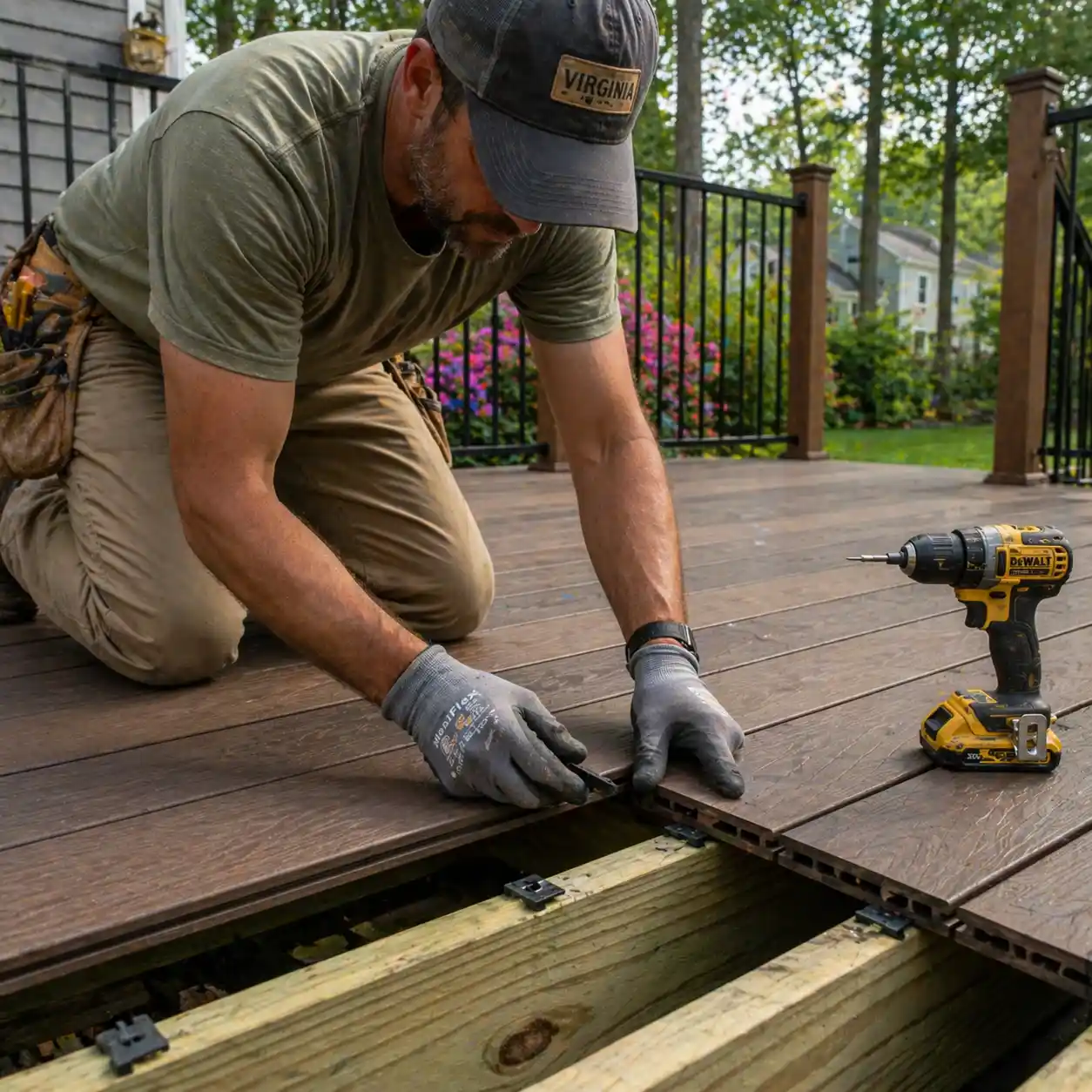
PVC expands and contracts more with temperature changes than composite. End gaps and side gaps must be sized to the manufacturer’s specifications for the installation temperature, accounting for the board’s full seasonal expansion range. Insufficient gaps will cause buckling in summer heat. We follow the manufacturer’s gapping specifications precisely on every PVC installation — the correct gap at 50°F is different from the correct gap at 80°F installation temperature.
Hidden Fastener Systems
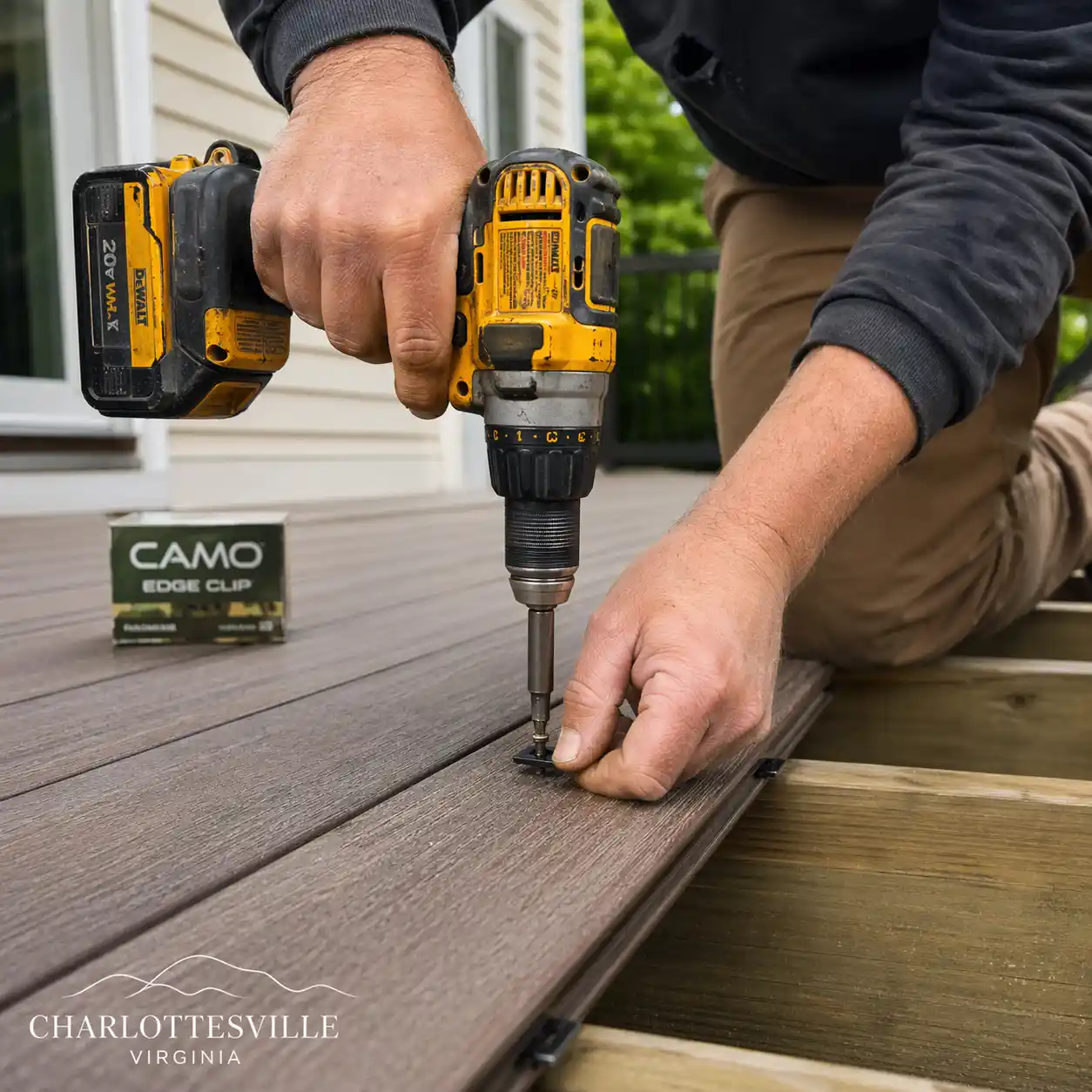
Like premium composite, most PVC decking is designed for hidden fastener installation. The specific fastener clip system is product-specific — using the wrong system can void the warranty and affect the board’s ability to expand and contract freely. We use the manufacturer-specified fastener system for every PVC product we install and never substitute generic clips to save cost.
Framing Requirements
Many PVC products require 12-inch joist spacing rather than the 16-inch spacing used for wood decking. Diagonal installations may require even tighter spacing. Building on framing that doesn’t meet the manufacturer’s requirements results in a deck that flexes noticeably underfoot — a common problem when PVC decking is installed over existing framing designed for wood. We build or confirm the framing to the product’s specifications before installation begins.
Services Often Paired With PVC Decking
PVC decking is most often chosen as part of a complete deck build, a pool deck project, or a deck replacement where the material is being upgraded.
Pool Decks
PVC is our standard recommendation for pool deck applications. The combination of complete moisture resistance, chemical resistance, and slip-resistant texture makes it the strongest performing material for a poolside environment. If you’re building around a pool, PVC decking should be your starting point for the material conversation.
Learn More →Deck Replacement
Deck replacement is a natural point to upgrade from wood to PVC. If you’ve been dealing with staining, splintering, or heavy maintenance on an older wood deck, replacement with PVC eliminates those issues for the long term. We include material comparisons in every replacement project consultation.
Learn More →Composite Decking
Not sure whether PVC or composite is right for your project? We install both and can give you an honest side-by-side comparison based on your specific environment, usage, and budget — so you’re choosing between them with clear information rather than marketing claims.
Learn More →PVC Decking Questions We Hear Often
Straight answers to the questions homeowners ask most before deciding on PVC decking.
In specific situations, yes — pool decks, high-moisture environments, and heavily shaded areas with tree debris being the clearest cases. For a standard residential deck in a typical environment, premium capped composite performs well enough that the additional cost of PVC isn’t justified by a meaningful difference in results. We give you a specific recommendation based on your project, not a default toward the more expensive product.
Current PVC decking products have improved significantly in appearance and now offer realistic wood-grain textures and natural-looking color variation. They don’t look exactly like natural wood — the grain pattern repeats across boards — but the visual difference is subtle enough that most homeowners are satisfied with the appearance at normal viewing distances. Where PVC historically fell short on appearance compared to composite, better embossing and multi-tone color processes in current products have largely closed that gap.
PVC decking in direct sun can get hot — similar to dark composite. Light-colored PVC runs meaningfully cooler than dark-colored boards in the same conditions, so color selection matters for decks in full sun. PVC does tend to run slightly cooler than composite of equivalent color because of differences in material composition. For pool decks where barefoot traffic is constant, we always recommend lighter color options and discuss the heat retention question directly with every client.
We work with several PVC decking products and don’t have an exclusive relationship with any single brand. At your consultation we discuss the specific options available, their warranty terms, available colors and textures, and price points — and recommend the product that fits the project and budget rather than defaulting to any particular brand. The PVC market has strong products from multiple manufacturers, and the right choice depends on the specific application.
Quality PVC decking is typically warranted for 30 years or more for structural integrity and fade and stain resistance. Real-world service life in residential applications with proper installation and routine cleaning often exceeds warranty terms. PVC doesn’t have the wood-fiber component that limits composite longevity in demanding environments, which is why PVC consistently outlasts composite in poolside and high-moisture applications over a 20- or 25-year horizon.
Ready to Talk About PVC Decking?
Fill out the form and we’ll schedule a free on-site consultation. We’ll look at the site, understand how the deck will be used, and give you an honest comparison of PVC vs. capped composite for your specific situation — including straightforward guidance on whether the additional cost of PVC is justified by what your project actually needs.
- Honest PVC vs. composite comparison based on your environment and usage
- Product recommendations that match the application — not the highest margin option
- Manufacturer-spec installation — correct gapping, fastener system, and joist spacing
- Written proposal with firm pricing before any work is scheduled
Request a Free Estimate
Fill this out and we’ll be in touch to schedule your free consultation.