Composite Decking in Charlottesville, VA
Composite decking has improved considerably over the past decade and now represents a genuinely practical option for most homeowners in central Virginia. Lower maintenance than natural wood, better moisture resistance, and a consistent appearance over time — but not all composite products are equal, and the quality gap between entry-level and mid-tier boards is significant. We help you choose the right product for your situation, not just the one on sale.
Request a Free Estimate
Tell us about your project and we’ll schedule a free on-site consultation — no obligation.
Better Than It Used to Be — but Not All Products Are Equal
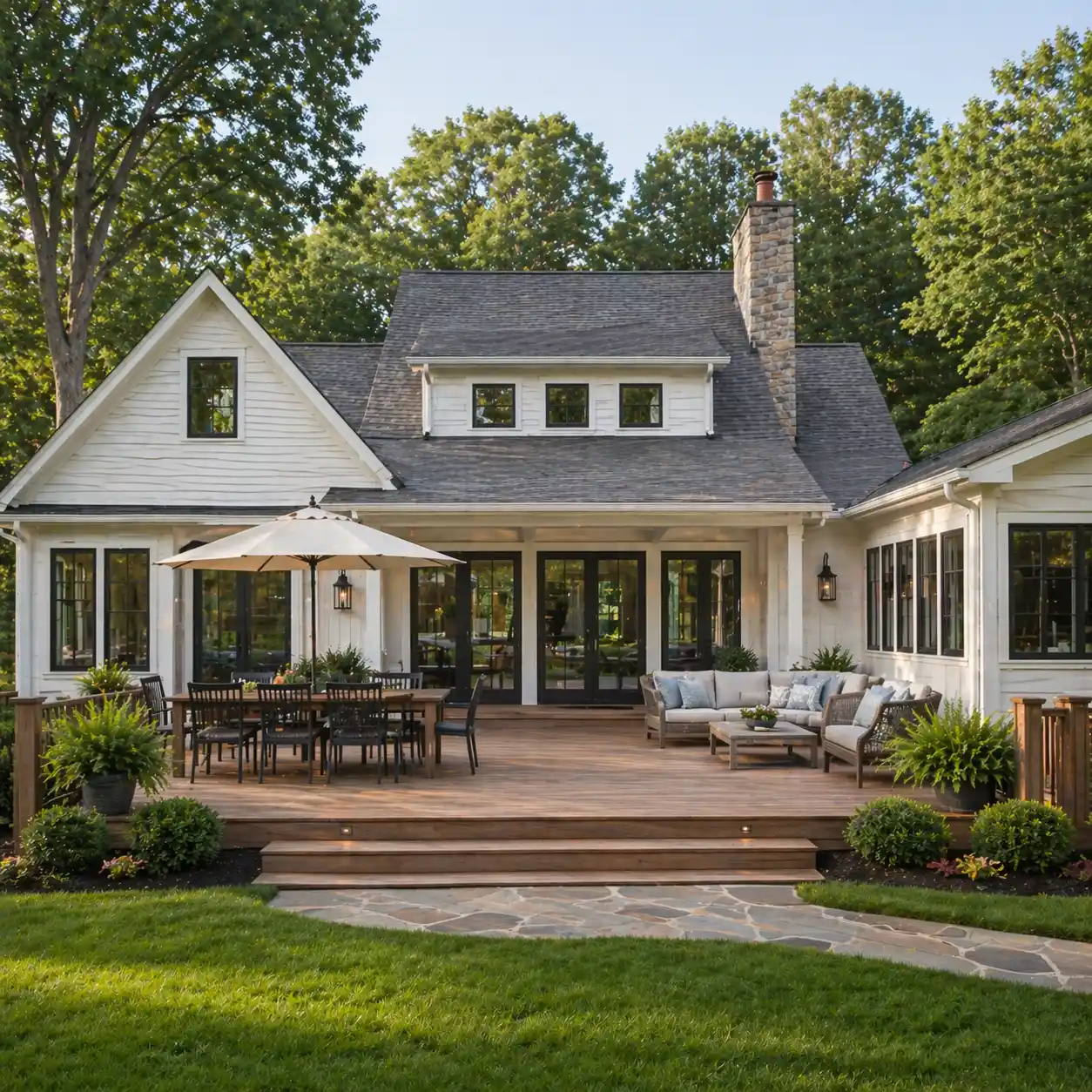
Early composite decking had real problems — it faded badly, it stained easily, and it didn’t look much like wood. Those issues pushed a lot of homeowners back toward pressure-treated lumber, and understandably so. The products available today are a significant improvement. Capped composite boards — where a protective shell surrounds the wood-fiber core — resist staining, hold their color much better, and feel and look closer to natural wood than anything available ten or fifteen years ago.
That said, there’s still a real quality gradient across the composite market. Entry-level products perform better than old-generation composites but still fall short of mid-tier and premium boards in terms of fade resistance, scratch resistance, and long-term appearance. The warranty terms are often the clearest indicator — manufacturers who stand behind 25- or 30-year fade and stain warranties on their products are typically offering something meaningfully different from those offering 10-year coverage.
We work with composite products across the quality range and can give you a frank assessment of what the differences actually mean for a deck in central Virginia’s climate. We don’t push clients toward the premium end when the application doesn’t warrant it, and we don’t recommend entry-level products on builds where the environment or usage pattern will expose their limitations quickly.
Schedule a Free ConsultationWhy Composite Makes Particular Sense in Central Virginia
Virginia’s climate is demanding on deck materials. The combination of hot humid summers, cold winters, and significant year-round moisture creates conditions where the maintenance case for composite is stronger than in drier or more temperate regions.
Handles Humidity Better
Virginia’s summer humidity is consistently high, and that moisture environment accelerates the deterioration of natural wood that isn’t regularly sealed. Composite boards don’t absorb moisture the way wood does — capped composite in particular has a moisture-resistant shell that prevents water absorption almost entirely. That’s the characteristic that makes composite perform so much better than wood in this climate over a 10- or 15-year period.
Resists Freeze-Thaw Cycling
Wood absorbs water and then expands when that water freezes — the repeated cycling through freeze and thaw seasons causes splitting, nail popping, and surface checking in pressure-treated boards over time. Composite materials don’t absorb water to begin with, so they don’t experience the same mechanical stress from seasonal temperature changes. This is particularly relevant in the northern parts of our service area where winters are colder and freeze-thaw cycles are more frequent.
No Staining or Sealing Required
A pressure-treated wood deck needs staining or sealing every two to three years to maintain its appearance and prevent surface deterioration. On a 400-square-foot deck, that’s a meaningful time commitment even if you do it yourself, and a recurring cost if you hire it out. Composite decking eliminates that maintenance cycle entirely — periodic cleaning is all it needs to hold its appearance over its service life.
Splinter-Free Surface
Pressure-treated wood develops surface checking and splinters as it weathers — a particular concern for families with children or anyone who uses the deck barefoot. Composite decking maintains a smooth, splinter-free surface throughout its service life. The texture is consistent from the day it’s installed, and it doesn’t develop the raised grain or surface roughness that weathered wood boards produce over time.
Consistent Color Over Time
Quality capped composite boards hold their color well compared to earlier-generation composites and compared to natural wood that hasn’t been recently stained. A deck that looks the same in year eight as it did in year one is something composite can deliver and natural wood generally can’t without consistent maintenance intervention. Premium products with long fade warranties back this up with manufacturer coverage.
Wide Range of Colors and Textures
Modern composite decking is available in a wide range of colors and wood-grain textures — far more variety than stained wood can offer. Whether you want a warm cedar tone, a cool grey, or a rich espresso color, composite products can deliver it consistently across the entire deck surface without the variation in uptake you get when staining natural wood.
Understanding the Difference Between Product Tiers
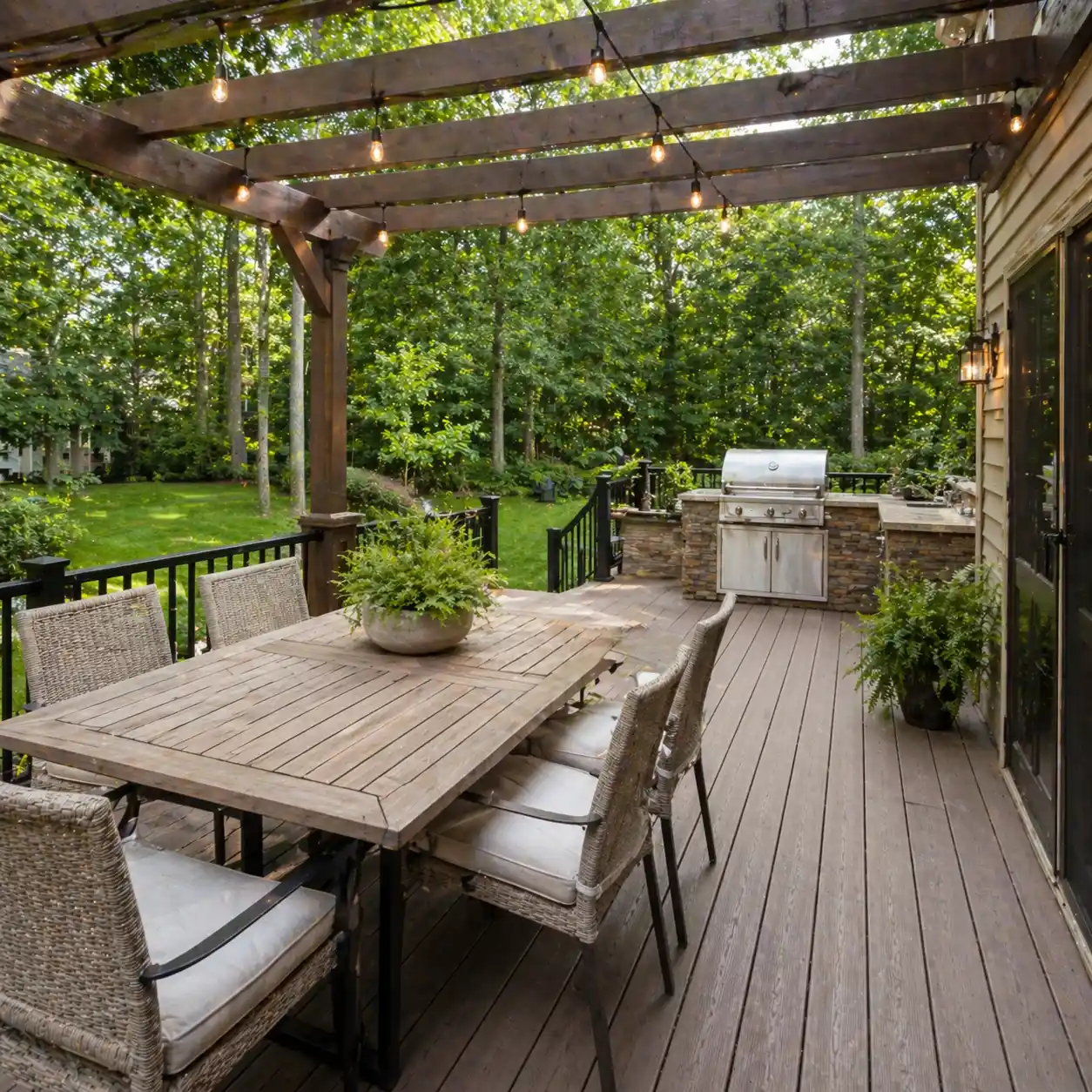
The composite decking market has three broad product categories, and the differences between them matter more than most homeowners realize before they’ve bought and installed one.
- Uncapped composite — Wood fiber and plastic mixed without a protective outer shell. More susceptible to staining, fading, and moisture absorption than capped products. Generally the lowest-cost option. Less common in new builds but still encountered on older decks.
- Capped composite — A protective polymer shell surrounds the wood-fiber core on three or four sides. Significantly more resistant to staining and moisture than uncapped products. This is the standard for new builds and the category where most mid-tier products fall. Four-sided capping offers better protection than three-sided.
- Full PVC decking — No wood fiber in the core — entirely synthetic material. Maximum moisture resistance and the longest service life of any composite-category product. Holds its color and texture well in demanding environments including poolside and lakefront applications. Higher upfront cost but the most durable low-maintenance option available.
We work with all three categories and can help you understand which tier makes sense for your specific project — accounting for the environment the deck will be in, how the space will be used, and what your budget allows.
Composite Decking Requires Correct Installation to Perform
The material is only part of the result. Composite decking installed incorrectly will develop problems regardless of how good the product is — and the installation details that matter most are specific to composite, not shared with wood deck construction.
Expansion Gap Requirements
Composite boards expand and contract with temperature changes more than wood does. Manufacturer specifications for end gaps, side gaps, and the gap at the house wall are specific to each product and must be followed precisely. Install composite too tight and it will buckle in summer heat. Each product we install is gapped to the manufacturer’s specifications for the temperature at installation, accounting for seasonal expansion.
Joist Spacing
Many composite boards require tighter joist spacing than standard wood decking — 12-inch on-center rather than 16-inch is common, particularly for diagonal or picture-frame installations. Installing composite on framing that was designed for wood decking can result in boards that flex noticeably underfoot. We build the framing to the manufacturer’s specifications for the specific composite product being installed, not to a generic deck framing standard.
Hidden Fastener Systems
Most mid-tier and premium composite products are designed for hidden fastener installation rather than face-screwing. Hidden fasteners clip into the grooved edge of each board, securing it to the joist without any visible hardware on the surface. The result is a cleaner-looking deck with no screw holes to fill or exposed fasteners to rust. Using the correct fastener system for the specific board is important — the wrong fastener can void the manufacturer warranty.
Other Services to Consider
Composite decking is typically part of a complete deck build. Here are the services most commonly combined with a composite deck project.
Custom Deck Building
Composite decking is a material choice within a complete custom deck build. We design the deck structure, framing, and layout around your specific property and then install the composite boards to manufacturer specifications for the product chosen.
Learn More →Deck Railings
Composite decking pairs well with aluminum, cable, or composite railing systems that share its low-maintenance characteristics. Mixing composite decking with a wood railing system that requires staining works against the maintenance advantage composite provides — we help you choose railing materials that make sense alongside the decking.
Learn More →PVC Decking
If composite decking’s moisture resistance performance interests you but you want maximum durability — particularly for poolside, lakefront, or high-moisture applications — full PVC decking is worth understanding as an alternative. We install both and can help you decide which makes more sense for your specific situation.
Learn More →Composite Decking Questions We Hear Often
If your question isn’t here, reach out and we’ll give you a direct answer.
It depends on how long you intend to stay in the house and how much value you place on not having to maintain the deck. The upfront cost of composite is typically 30 to 50 percent higher than pressure-treated for the decking boards themselves, but the lifecycle economics often favor composite for homeowners who will own the deck for ten or more years — particularly when you factor in the cost and time of periodic staining or sealing for wood. For shorter time horizons or tighter budgets, pressure-treated is a perfectly good choice when built and maintained correctly.
Yes. Composite decking absorbs and retains heat more than natural wood or light-colored materials — dark-toned composite boards in direct sun can get quite hot in Virginia’s summer heat. This is a real consideration for decks with full afternoon sun exposure. Lighter color choices reduce the heat retention somewhat, and shade from a pergola or covered structure helps significantly. We discuss sun exposure and orientation at the consultation because it affects both material choice and color selection.
Most composite decking cleans easily with soap and water or a composite-specific deck cleaner. A soft-bristle brush handles most organic debris and surface staining. Power washing is generally fine on lower pressure settings — high-pressure washing can damage the board surface on some products. Tannin staining from leaves or planters sitting on the deck is the most common issue and is easiest to address promptly rather than letting it sit. The specific cleaning recommendations vary by product, and we provide care instructions for whatever board we install.
We work with a range of composite products across the quality tiers and don’t have an exclusive relationship with any single manufacturer. At your consultation we’ll discuss the options that make sense for your project — the specific performance characteristics, warranty terms, available colors, and price points that are relevant to what you’re building. Our goal is to match you with the product that fits your situation, not to move a particular brand.
Yes. Most composite decking products are available in stair tread configurations — either purpose-made treads or standard boards used as treads. Stair stringers are typically built from pressure-treated lumber regardless of the decking material used on the main deck surface. We match the stair tread material to the deck surface so the overall project has a consistent appearance, and we use the appropriate composite or PVC nosing profile where the product requires it.
Quality capped composite products are typically warranted for 25 to 30 years for structural integrity and 25 years for fade and stain resistance. Real-world performance depends on the product quality, the installation quality, the environment the deck is in, and how it’s maintained. Mid-tier and premium products installed correctly in typical residential applications regularly last 25 years or more without significant degradation in appearance or performance. Entry-level products in demanding environments — poolside, full sun, heavy use — may show their limitations sooner.
Ready to Talk About Composite Decking?
Fill out the form and we’ll schedule a free on-site consultation. We’ll look at the site, discuss what you’re building, and walk you through the composite options that make sense for your specific situation — including an honest comparison with pressure-treated lumber if you’re still weighing the two. No obligation to commit on the spot.
- Honest comparison of composite vs. wood options for your project
- Product recommendations based on your budget and usage — not our margin
- Installation to manufacturer specifications including correct joist spacing and expansion gaps
- Written proposal with firm pricing before any work is scheduled
Request a Free Estimate
Fill this out and we’ll be in touch to schedule your free consultation.