Multi-Level Decks in Charlottesville, VA
Multi-level decks solve a real problem — when a single flat deck either doesn’t fit the yard’s topography or doesn’t give you the separate zones you want for different activities. A properly designed multi-level deck makes a sloped yard functional, creates natural separation between dining and lounging areas, and connects the house to the yard in a way a single platform often can’t.
Request a Free Estimate
Tell us about your project and we’ll schedule a free on-site consultation — no obligation.
The Right Solution for Sloped Properties and Larger Spaces
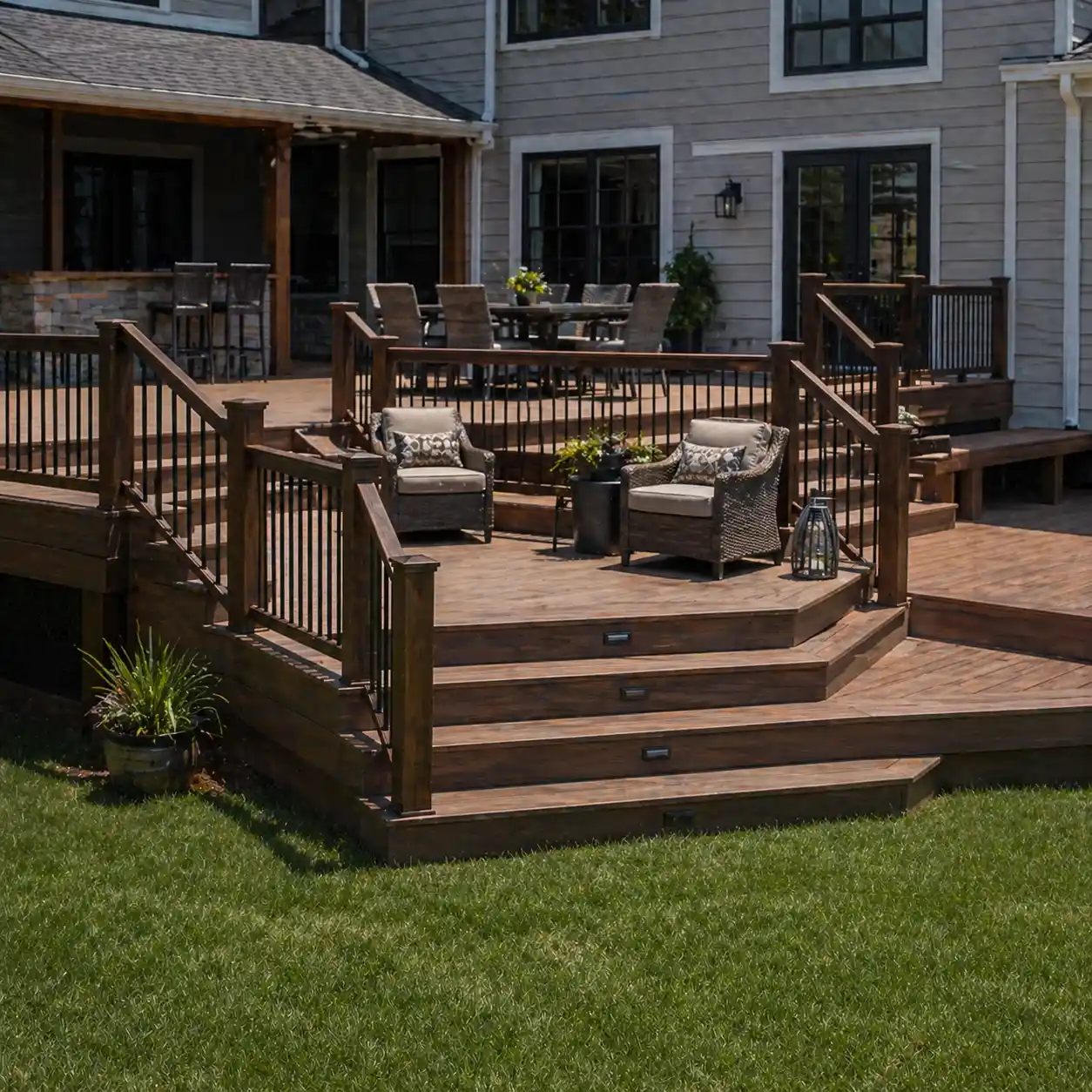
Central Virginia’s terrain gives many homeowners sloped backyards that make a single flat deck difficult to site well. A deck built at door height off a sloped yard is too high above the yard at the far end to feel connected to the ground. A deck built at yard level at the far end means either a ramp or a significant step down from the house. Multi-level decks solve this by following the grade — each level sits at an appropriate height relative to the house and the yard, connected by stairs that feel natural rather than awkward.
Beyond topography, multi-level decks work well when you want distinct zones for different activities. A dining area at door height from the kitchen, a lounging area one level down with a different orientation or view, and a ground-level patio or fire pit area connected by stairs — this kind of organization of outdoor space functions better than a single large platform where everything competes for space.
The structural and design complexity of a multi-level deck is real, and the permit and engineering requirements reflect that. We design multi-level decks from the structural foundation up — footings, post heights, beam spans, and load paths are all calculated for each specific site rather than applied from a generic template.
Schedule a Free ConsultationHow Multi-Level Decks Are Typically Designed
Multi-level decks come in many configurations depending on the site and what the homeowner is trying to accomplish. These are the arrangements we see most often in central Virginia.
Grade-Following Terraced Decks
On properties with significant slope, a terraced multi-level deck follows the grade down from the house in two or three platforms. Each level drops one to three feet below the previous, connected by stairs that feel like a natural transition rather than an abrupt step. This approach makes a sloped yard fully usable as outdoor living space — without requiring retaining walls or significant excavation to create a flat surface.
Upper Deck / Lower Patio Combinations
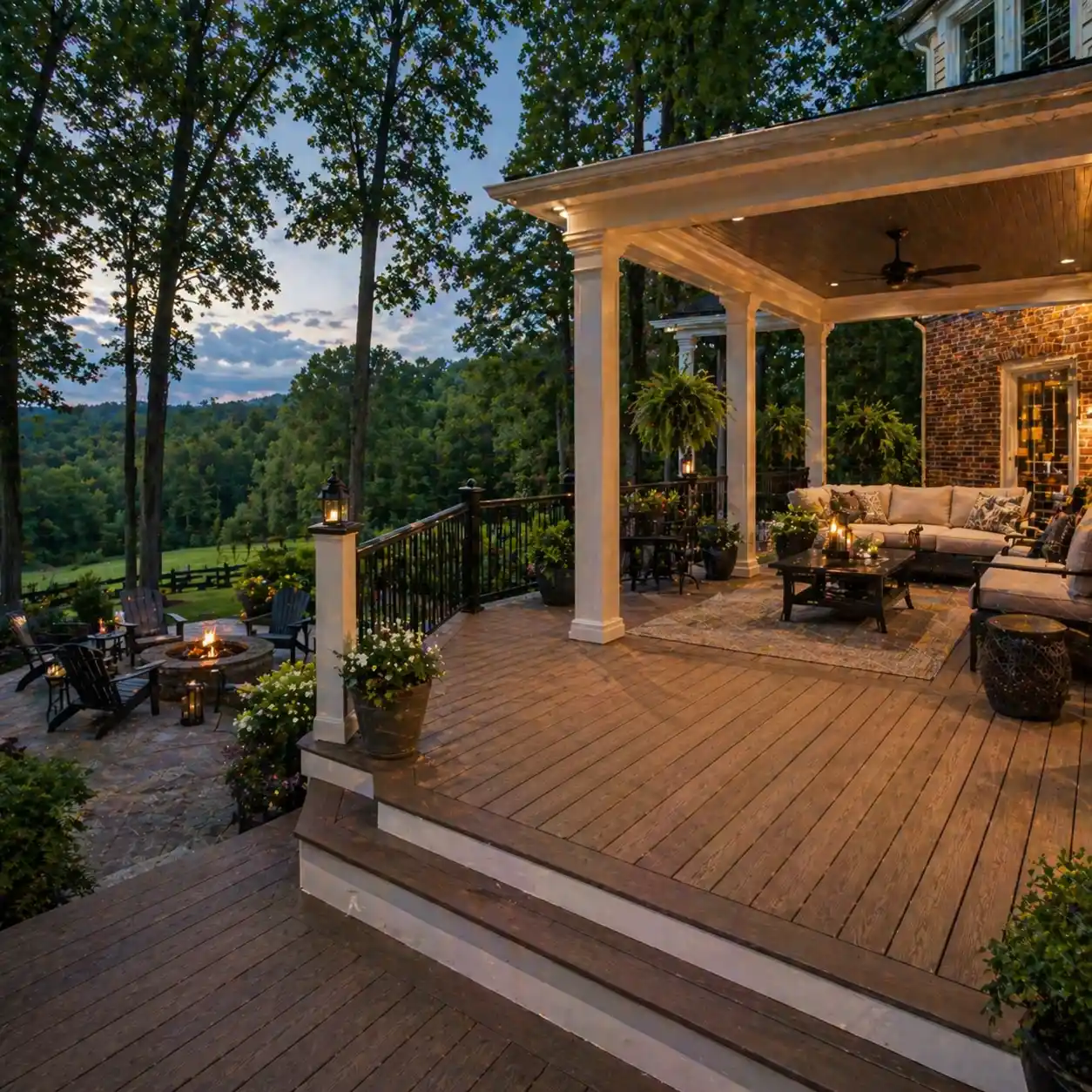
A common configuration for elevated decks — the upper deck is at door height from the house, and the space underneath is used as a covered patio or ground-level lounge area. The upper deck provides the outdoor living connection to the house, and the shaded space below adds a second usable zone that stays cool in summer. This approach is especially popular on homes where the yard drops away significantly from the foundation.
Zone-Differentiated Flat Lots
Even on relatively flat lots, a two-level design can create useful separation between zones. A dining area at door height and a lounging or hot tub area one step down — even just 18 to 24 inches — creates a sense of distinct spaces that a single-level deck doesn’t achieve. The level change defines the zones without requiring walls or barriers, and the stairs between them can be designed as a design feature rather than just a transition.
Pool Deck Integrations
Multi-level decks connecting the house to a pool are common configurations in central Virginia. The upper level connects to the house at door height, a middle level may serve as a transition and seating area, and a lower pool deck surrounds the pool at pool coping height. The transitions between levels need to be designed for wet-foot traffic, which affects material choices, surface texture, and step height and depth throughout.
Corner & Wrap Configurations
Multi-level decks that wrap around a corner of the house — one level on the back, another stepping down on the side — take advantage of the full footprint the house allows while managing grade changes along two different walls. These designs require careful attention to how the deck attaches at each wall and how water is managed at the inside corner, where two ledger boards meet.
Fire Pit & Entertainment Zones
A dedicated fire pit area at the lowest level, reached by stairs from the main deck, creates a natural gathering zone that’s physically separated from the dining and cooking area. The separation is practical — it keeps the main deck clear of smoke when the fire is going — and it creates a sense of destination, as if the yard has multiple places to be rather than just one outdoor room attached to the house.
What Makes Multi-Level Decks More Complex to Build
Multi-level decks require more structural planning than single-level builds, and the difference matters for both safety and longevity. The key structural considerations that change with a multi-level design include:
- Post heights and lateral bracing — Taller posts require lateral bracing to resist the racking forces that wind and live load create. The bracing system needs to be designed for the specific post heights and configuration, not assumed from a standard detail.
- Multiple ledger attachment points — Each level that attaches to the house has its own ledger with its own flashing requirements. The relationship between ledger heights and the house’s floor and rim joist locations affects where each ledger can be placed and how it’s waterproofed.
- Load transfer between levels — On decks where one level bears on another, the load path from the upper level through the lower level to the footings needs to be accounted for in the framing design. This affects beam sizing, post sizing, and footing capacity requirements.
- Footing design for sloped sites — On significantly sloped properties, footings at different elevations may be in different soil conditions. Each footing needs to reach below the frost line and bear on stable soil, which on a sloped site may require footings of different depths at different locations.
- Permit and inspection requirements — Multi-level decks almost always require engineered drawings in Charlottesville and surrounding jurisdictions, particularly when any portion of the deck is more than 30 inches above grade. We handle the permit and inspection process as part of every multi-level build.
Services Often Combined With Multi-Level Builds
Multi-level decks are often part of larger outdoor living projects. Here’s what we most commonly design alongside them.
Custom Deck Building
Multi-level decks are a specialty within our broader custom deck building work. We design the full project — layout, framing, material selection, and permit drawings — from the first site visit through the finished build.
Learn More →Pool Decks
Pool deck integrations often call for a multi-level approach — an upper deck at house level connecting to a pool-level surround via stairs. We design these connections so the full run from house to pool feels intentional and continuous, not like two separate projects joined at the middle.
Learn More →Deck Lighting
Multi-level decks benefit particularly from good step and riser lighting — the level changes that make a multi-level design work also create the potential for trips and missteps in the dark. We plan lighting alongside the structural design so wiring runs are incorporated into the build, not added later.
Learn More →Multi-Level Deck Questions We Hear Often
Straight answers to the questions that come up most before a multi-level deck project.
Usually, yes — though the specifics depend on how much slope there is, what direction it runs relative to the house, and what you want to do with the space. Gentle slopes of 1 to 2 feet over 12 to 15 feet can often be handled with a single-level deck that’s slightly elevated on one end. More significant slopes — 3 feet or more — typically benefit from a multi-level approach. We assess the grade at the consultation and make a specific recommendation based on what we find.
A multi-level deck with comparable total square footage costs more than a single-level build — typically 20 to 40 percent more depending on the configuration. The additional cost comes from more framing complexity, more footings, additional stair construction, and more extensive railing requirements at each level. The per-square-foot cost is higher, but the functional result is meaningfully different — the multi-level design creates distinct zones and manages grade in a way a single-level platform can’t match.
In most cases, yes — particularly when any portion of the deck is more than 30 inches above grade, which is common with multi-level builds on sloped lots. Local jurisdictions including Charlottesville, Albemarle County, and surrounding areas typically require stamped engineered drawings for decks over this height threshold. We handle the permit and engineering coordination as part of every multi-level project, and permit costs are passed through at actual cost with no markup.
Yes. A common approach is composite decking on the upper level — where it sees more use and foot traffic — and pressure-treated on a lower level or ground-level patio area. Another option is using different colors of composite across levels to define the zones visually. We discuss material selection at the design stage in the context of the whole project, so the material choices across levels make sense together rather than just on each level individually.
The underdeck space on an elevated upper level can be finished as a covered lower patio — a popular option in central Virginia where summer shade is valuable. This requires a drainage system that captures water from the deck above and directs it away, a ceiling material (typically aluminum panels or a tongue-and-groove system), and typically a lighting plan for the shaded space below. We design underdeck systems as part of the overall deck project when the height and site conditions make it a good option.
Ready to Design Your Multi-Level Deck?
Fill out the form and we’ll schedule a free on-site consultation. We’ll walk the property, assess the grade, and talk through what configuration makes the most sense for your site. Every multi-level deck we build starts with a site visit — the topography and house layout have to inform the design, and that can’t be done from a phone call.
- Free on-site assessment — we walk the grade and evaluate the property before designing anything
- Full structural design accounting for slope, post heights, and load paths
- Permit and engineering coordination included in every multi-level project
- Written proposal with firm pricing before any work is scheduled
Request a Free Consultation
Tell us about your property and we’ll schedule a free site visit.